Wanderwares
ResearchMSP
Run the PM Automation Leak Audit

Property Management Research

Owner Distribution Reconciliation Exceptions in Property Management Software

Owner distributions look like a monthly accounting task. In practice, they are an exception queue for unreconciled transactions, reserve rules, stale checks, and ledger mismatches.

August 26, 2026·~7 min read·Research note

Methodology

Methodology

This article uses current public regulator guidance and vendor-published accounting material. The regulator sources establish the control requirements behind monthly reconciliation. The vendor sources show where software helps, and where unmatched items, owner draws, reserves, and review steps still leave work for an operator. This is directional workflow research, not legal or accounting advice.

Why owner payouts become exception work

Owner distributions can look simple from the outside: rent comes in, bills and management fees come out, and the remaining cash is paid to the owner. The actual monthly workflow is more conditional. A manager has to confirm that bank activity is reconciled, that the property ledger has enough available cash, that required reserves are being held back, that outstanding checks or deposits are understood, and that the owner statement will explain the month without triggering another round of questions.
That is where modern property management software still leaves a review queue. The platform may hold the ledger, import bank transactions, and generate owner statements, but the judgment around whether money is actually distributable often sits with a human. Buildium describes owner distributions as a process that starts with reconciled trust accounts, net cash calculations, reserve rules, and then batch payments or statements. It also notes that when the process is not handled cleanly, it can become a time-consuming monthly task with reconciliation headaches and relationship-damaging errors.4

Workflow

System handles
Exception
Human required

Rent and other income are posted to the property ledger

Vendor bills, utilities, fees, and reimbursements are entered

Bank activity is matched against PMS records

Exception queue appears

Unmatched bank transaction

Outstanding check or deposit in transit

Low balance after reserve requirement

Charge coded to the wrong property or owner

Bookkeeper or manager decides whether to hold, adjust, explain, or release owner funds

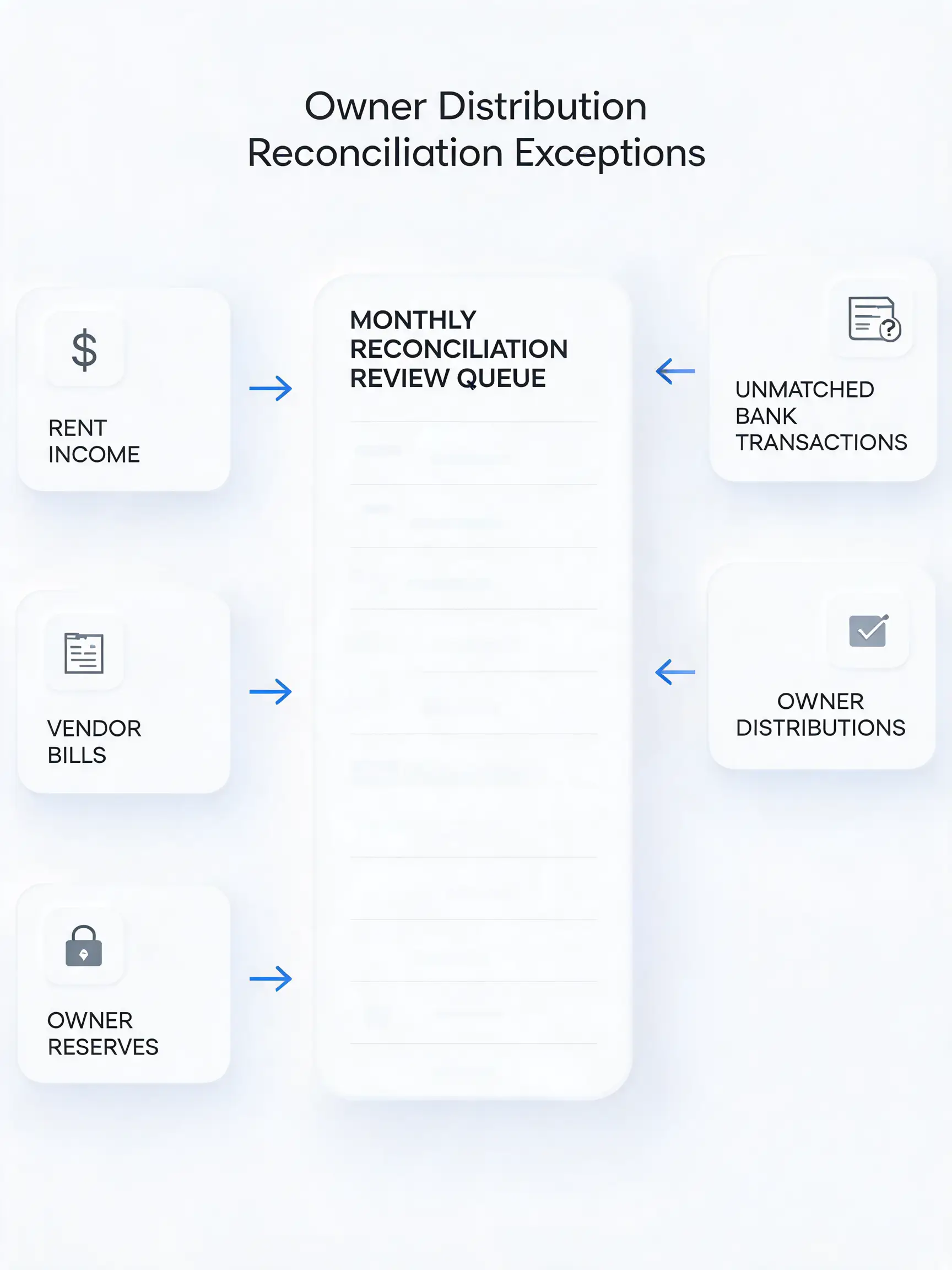
Workflow visual showing rent income, vendor bills, owner reserves, unmatched bank transactions, and owner distributions flowing into a monthly reconciliation review queue.
A simplified view of the monthly exception queue that can block owner distributions.

The regulatory shape of the problem

The reason these exceptions matter is that property management accounting is not ordinary small-business bookkeeping. In many states, client money must be traceable by account, owner, tenant, or transaction. Oregon's property management rule requires a monthly reconciliation with three components: the adjusted bank statement balance, the receipts and disbursements record or check register, and the sum of positive owner ledgers. If an adjustment is needed, it has to be identified and explained; unresolved adjustments must be corrected before the next reconciliation or supported by documented good-faith efforts.1

North Carolina's trust money rule has a similar operational shape. It requires a monthly reconciliation that compares a property or owner ledger trial balance, the reconciled bank statement balance, and the journal balance. If those amounts do not agree, the broker must investigate the variation and make corrections. In practical terms, the month cannot simply be closed because the bank feed imported. The manager still needs to resolve why three views of the same client money disagree.2

The exception is the work

A reconciled month is not just a matched bank account. It is a documented agreement between bank reality, the PMS journal, and owner or tenant sub-ledgers. Any gap between those systems becomes a task that software can surface but not always resolve.

Where software helps

Run the PM Automation Leak Audit

The counterevidence is real: the major platforms have moved a lot of accounting work out of spreadsheets. AppFolio says its Bank Feed retrieves bank transactions, cross-references them against system records, and automatically matches a large share of transactions. Its accounting product page also emphasizes automated transaction matching, bank integrations, eCheck payments, CAM reconciliation, owner contributions, and reporting in one platform.35

Buildium makes a similar practical argument from the operator side. Its accounting guidance recommends weekly reviews, prompt research on unmatched transactions, documented adjustments, variance thresholds, and owner balance checks before distributions. Those recommendations are not a rejection of software. They assume software is central to the workflow, while acknowledging that clean books still require exception handling and review discipline.4

Automation boundary

Match, then review

Bank-feed automation reduces data entry and highlights likely matches. It does not eliminate the need to decide what to do with unmatched, stale, misclassified, or low-balance cases.

The hidden queue before the owner statement

The hidden queue sits between matching transactions and sending owner statements. An unmatched deposit might be rent posted to the wrong unit, owner money placed in the wrong ledger, a payment processor batch that needs to be split, or a tenant payment that arrived after the cutoff. An uncleared check might be harmless timing, or it might be a stale vendor payment that affects available cash. A negative property balance might be a real owner deficit, a missing reimbursement, or a coding error.

These cases are small individually, but they block downstream automation. A batch owner draw is only safe when each property's available balance, reserve rule, expenses, and pending items have been checked. Buildium's guidance explicitly warns that paying owners before verifying available funds can create property-level deficits, and recommends reviewing low or negative balances before processing distributions.4

  • Unmatched transactions require research, not just matching.
  • Owner distributions require available-cash decisions at the property level.
  • Reserve rules come from agreements and may not be inferable from the transaction alone.
  • Outstanding checks and deposits can change whether a payout is safe.
  • Statement explanations often require human-readable context for owners.

What Wanderwares should watch

The automation opportunity is not replacing trust accounting controls. It is watching the accounting exception queue before it turns into a delayed owner statement, a compliance scramble, or a month-end bottleneck. A useful layer would monitor unmatched bank-feed items, stale outstanding checks, properties below reserve thresholds, owner draws held for review, and adjustments that appear repeatedly across closes.

The strongest near-term workflow is triage and follow-up: identify which exceptions are blocking owner distributions, assign the owner of each exception, summarize the evidence needed to clear it, and nudge the responsible person until the case is resolved or explicitly deferred. That keeps the human in control of regulated money while removing the recurring work of rediscovering the same stuck items every month.

Run the PM Automation Leak Audit

Sources

  1. [1]863-025-0028 Clients' Trust Account Records and Reconciliation - Oregon Secretary of State Administrative Rules
  2. [2]21 N.C. Admin. Code 58A .0117 - Accounting for Trust Money - Legal Information Institute
  3. [3]Fine-tune Your Monthly Accounting With AppFolio Bank Feed - AppFolio
  4. [4]10 property management accounting best practices that prevent costly mistakes - Buildium
  5. [5]Property Management Accounting Software - AppFolio

Based on publicly available regulator guidance and vendor documentation. This article is operational research, not legal, accounting, or compliance advice.

← See all research
Wanderwares

Find the manual work your business software leaves behind.

Product

PM Automation Audit

Company

ResearchMSP Automation

Contact

luigi@trywanderwares.com
2026 Wanderwares. All rights reserved.